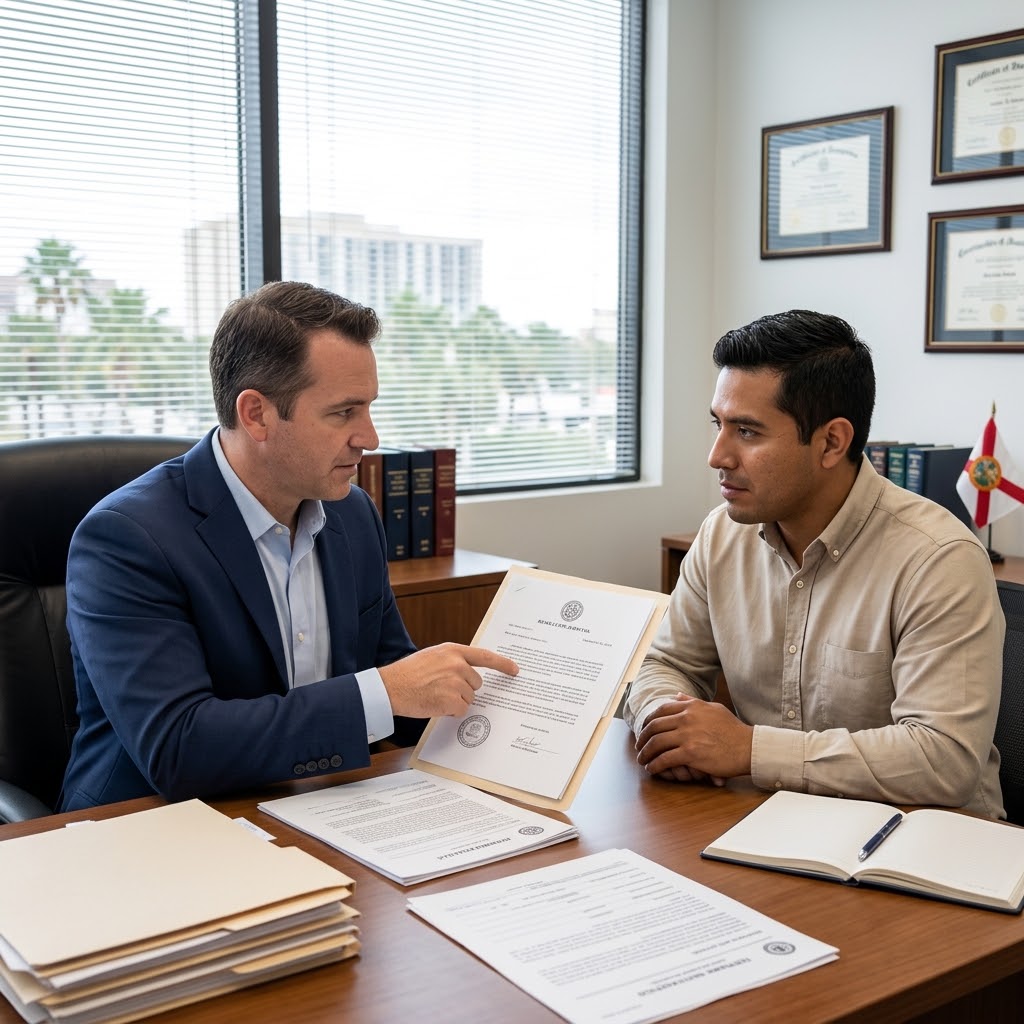
The nolle prosequi meaning is simple on paper: the prosecutor formally decides to stop prosecuting a criminal charge. The Latin phrase translates to “we shall no longer prosecute.” In Florida, the state attorney files it, and the criminal case ends without a trial, a verdict or a sentence.
If you are not a U.S. citizen, a nolle prosequi usually means there is no conviction, and that is good news. Still, the arrest, the police report and the court file do not disappear. Immigration officers and judges can read them years later.
That gap is why “they dropped my charge” is only part of the story. This guide covers the nolle prosequi meaning under Florida practice, how it differs from other case outcomes, what federal immigration law says, and why the exact wording of your court record matters.
What Is the Nolle Prosequi Meaning in a Florida Criminal Case?
A nolle prosequi means the prosecution walks away from the charge on its own decision. A judge does not declare you innocent, and no one rules that the evidence failed. The prosecutor announces that the state will not go forward on one charge or on all of them.
Prosecutors drop charges for different reasons: a witness who stops cooperating, a problem with the evidence, a deal with the defense, or office priorities. The closing document often does not state the reason, and that silence has consequences later.
Florida law treats the outcome as its own category. Fla. Stat. § 943.0585(1)(b) lists a charge “dismissed or nolle prosequi by the state attorney or statewide prosecutor” separately from a court dismissal, a judgment of acquittal and a not guilty verdict.
In some circumstances, the state could file charges again based on the same events. Whether that is possible depends on the time limits in Fla. Stat. § 775.15 and on the procedural rules that apply, so the full nolle prosequi meaning includes some remaining criminal risk.
Nolle Prosequi, Dismissal and Acquittal: How Are They Different?
The nolle prosequi meaning gets clearer next to the alternatives, because each one has a different decision maker. With a nolle prosequi, the prosecutor decides. With a dismissal, the court decides. With an acquittal, a judge or jury weighs the evidence and finds that guilt was not proven.
For immigration purposes, what matters most is whether there was a finding or plea of guilt and a penalty ordered by the judge. That is why a Florida withhold of adjudication, which people often confuse with a dropped charge, can lead to a very different result.
| Criminal case outcome | Who decides | Conviction under INA § 101(a)(48)(A)? | What immigration can still review
|
|---|---|---|---|
| Nolle prosequi | State attorney | Generally, no | The arrest, the police report and any admissions you made |
| Dismissal by the court | Judge | Generally, no | The arrest and the facts in the court file |
| Acquittal or not guilty verdict | Judge or jury | No | The arrest, which you still disclose on forms |
| Withhold of adjudication with a guilty plea and probation | Judge, after the plea | Yes, if there was guilt plus some penalty or restraint | The immigration conviction and its categories |
| Adjudication of guilt | Judge or jury | Yes | The conviction, the sentence and its effect on deportability |
Read this way, the nolle prosequi meaning for immigration is narrower than most people assume. The table compares outcomes, not crimes, and the effect in a real case depends on the wording of the statute, on what you signed or said, and on the discretion of each official involved.
Does a Nolle Prosequi Count as a Conviction for Immigration?
Generally, no: the USCIS Policy Manual states that a nolle prosequi does not meet the definition of a conviction. That definition lives in INA § 101(a)(48)(A), 8 U.S.C. § 1101(a)(48)(A), and it applies no matter what label the state uses.
A conviction exists when a court enters a formal judgment of guilt. When adjudication is withheld, there is still a conviction if two things happened: a finding or plea of guilt (including nolo contendere or admitting enough facts), and a penalty, punishment or restraint on liberty ordered by the judge.
The USCIS Policy Manual, Volume 12, Part F, Chapter 2 says it directly. In a clean nolle prosequi, there is no plea and no penalty, so both elements are missing.
“Clean” is the key word. If you signed a guilty plea before the charge was dropped, entered a program that required admitting facts, or made a confession that sits in the file, the analysis changes.
What the Record Still Says After the Charge Is Dropped
The criminal case closes, but the arrest record stays. The arrest, the police report and the court documents can weigh in discretionary immigration decisions even without a conviction. This is the part of the nolle prosequi meaning most people never hear about.
Good moral character and naturalization
Form N-400, Application for Naturalization, requires good moral character during the statutory period. INA § 101(f) lists conduct that bars a finding of good moral character, and it adds that falling outside the list does not stop an officer from finding a lack of it for other reasons.
The Form N-400 instructions ask you to report every offense, including expunged ones. For an arrest where charges were filed, they ask for arrest reports, charging documents and court dispositions.
That is why a review before a citizenship and naturalization application works best with the complete criminal file in hand, rather than a memory of how the case ended.
Adjustment of status and other discretionary benefits
Adjustment of status requires meeting the legal requirements and also earning a favorable exercise of discretion. According to the USCIS Policy Manual, the officer weighs the totality of the circumstances: a lack of criminal record counts in your favor, and public safety concerns count against you.
A dropped charge is not a conviction, but the arrest behind it can still land on that scale. How much it weighs depends on the facts in the report, the time that has passed and the evidence you provide.
When Can a Dropped Charge Still Hurt You?
Immigration law includes consequences that do not require a conviction. Two of them limit the nolle prosequi meaning for immigration, because they turn on what you admit or on what the government has reason to believe.
Admitting the elements of certain offenses
INA § 212(a)(2)(A)(i), 8 U.S.C. § 1182(a)(2)(A)(i), makes a person inadmissible if they admit committing acts that make up the essential elements of a crime involving moral turpitude or a controlled substance violation, even with no conviction.
Inadmissibility can block a green card, a visa or reentry after travel. The USCIS Policy Manual sets conditions for a valid admission: the officer provides the text of the law, explains its elements in ordinary language, and the person voluntarily admits those elements under oath.
“Reason to believe” in drug cases
INA § 212(a)(2)(C) makes a person inadmissible when a consular officer or the government knows or has reason to believe they are or have been an illicit trafficker in a controlled substance, or knowingly helped others traffic. This ground does not require a conviction.
So a police report describing sales or distribution can still matter after a nolle prosequi. The outcome depends on the specific evidence.
Sealing or Expunging a Florida Record: What Changes and What Doesn’t
Florida lets you petition to expunge a criminal history record when the charge ended in a nolle prosequi, under Fla. Stat. § 943.0585(1)(b), if you meet the other requirements. Sealing is covered by Fla. Stat. § 943.059.
A state expungement or sealing order does not make the case disappear for immigration. The Florida expunction statute lets you deny the arrest in many state settings, with listed exceptions. The federal N-400 instructions, however, ask you to report expunged offenses and provide the court order.
The USCIS Policy Manual adds that obtaining your records remains your responsibility even when they are sealed or expunged, and that expunging a conviction does not remove it for immigration purposes. Sealing does not change the nolle prosequi meaning on federal forms: the safe course is to disclose and document.
Why the Wording of Your Court Record Matters
The nolle prosequi meaning an officer takes away depends on paper, and two dropped cases can look very different. Immigration reads the document, so the wording of the final disposition and the filings before it can matter as much as the outcome.
The differences usually come down to details like these:
- whether the nolle prosequi covers every charge, or only some while another ends in a plea;
- whether you signed an agreement that included admitting facts;
- whether you entered a pretrial diversion program and what it required;
- whether the police report describes conduct that fits an immigration ground;
- whether you have a disposition certified by the clerk of court.
The USCIS Policy Manual requires certified dispositions for certain arrests even without a conviction, for example an arrest during the naturalization statutory period or for an offense that could make you removable.
Decisions made in the first 24 to 48 hours matter here. Taking a quick plea to get out of jail can turn a case that was heading toward a dropped charge into an immigration conviction.
In Florida, Fla. Stat. § 908.11 requires sheriffs and chief correctional officers who run county jails to enter 287(g) agreements with ICE. If detention is a risk or a removal case is open, it helps to coordinate deportation defense with the criminal defense from the start.
Understanding the process is the first step, and every case has details that change the strategy. To see how this applies to your situation, schedule a consultation with our team.
Frequently Asked Questions About Nolle Prosequi
Do I have to disclose an arrest if the charges were dropped?
Yes, on immigration forms that ask about it. The N-400 instructions ask for documents on arrests and detentions, including those where no charges were filed, and proof of how each case ended.
Leaving out an arrest can look like a lack of truthfulness, which often does more harm than the arrest itself.
Does a nolle prosequi protect me from ICE?
Not necessarily. It closes the criminal case, but it does not decide your immigration status. If you lack status or face other grounds, ICE can act for reasons that have nothing to do with the dropped charge.
In Florida, contact with ICE can happen at the county jail, before the prosecutor ever decides.
Is a nolle prosequi the same as a dismissal?
Generally, no. The prosecutor decides a nolle prosequi, while a judge decides a dismissal. Florida law lists them separately.
Neither is usually a conviction for immigration. The nolle prosequi meaning and the dismissal meaning differ mostly in the record each one leaves.
Should I expunge my record before applying for citizenship?
It can help for other purposes, but it does not hide the case from USCIS. The N-400 instructions ask you to report expunged offenses and provide the order.
Before you file for expunction, get certified copies of the disposition.
Can the prosecutor refile charges after a nolle prosequi?
In some circumstances, yes. It depends on the time limits in Fla. Stat. § 775.15 and the procedural rules in your case.
Confirm which charges the nolle prosequi covers and whether any charge is still pending.
What if I admitted the facts to the police?
That statement can matter, depending on how it was made and what it says. For a statement to count as an admission before USCIS, the Policy Manual requires specific formal steps.
Even so, a police report with a confession can influence discretionary decisions.
Nolle Prosequi Meaning in Practice: Your Checklist Before Any Immigration Filing
The practical nolle prosequi meaning for a noncitizen is this: there is usually no conviction, but there is still a record to manage.
- Request a certified disposition for each charge from the clerk of court, and confirm the nolle prosequi covers all of them.
- Get the arrest report and the charging documents, because the N-400 and other forms ask for them.
- Review what you signed during the case: plea forms, diversion agreements or statements with admissions.
- Disclose the arrest on every form that asks, even if the record is sealed or expunged.
- Keep copies before sealing or expunging, because getting them later can be harder.
- Evaluate your full immigration picture before a green card filing, a naturalization application or travel abroad.
- Coordinate criminal and immigration defense if a charge is pending, ICE has lodged a detainer or you are in immigration court.
Immigration law, agency policy and Florida rules change, so confirm the current information before you act. The court disposition requirements for naturalization are in the USCIS Policy Manual, Volume 12, Part F, Chapter 3.
If your case ended in a nolle prosequi and an immigration filing is ahead, consider talking with an attorney who can review both sides of your record.
This content is for general information only. It is not legal advice and does not create an attorney-client relationship. Every case depends on its own facts and on the law in effect when it is filed. To discuss your situation, contact Angel Law Firm at (407) 329-7711.