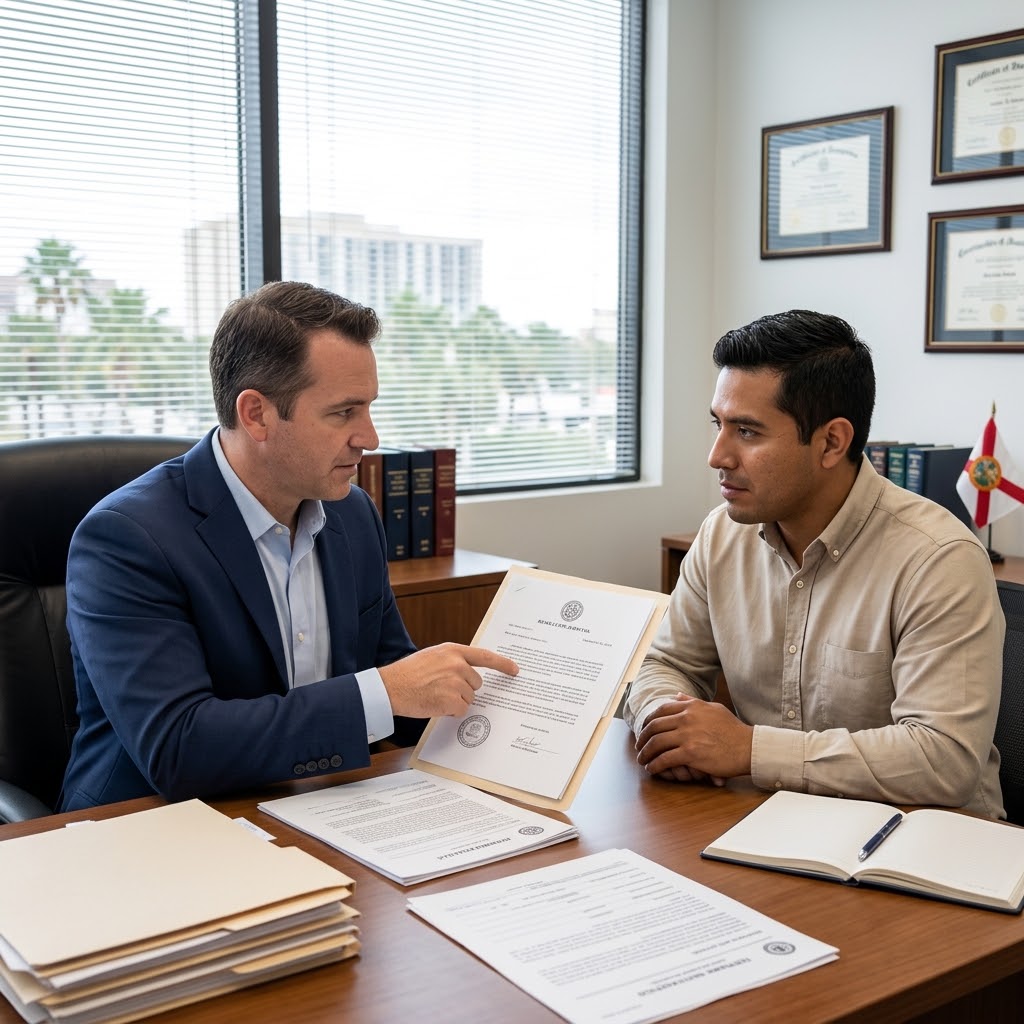
What many people call a ticket for driving without a license in Florida may constitute a misdemeanor under Florida Statutes § 322.03. Depending on the circumstances, a driver may receive a criminal citation or be arrested. For someone who is not a U.S. citizen, an arrest can also increase the risk of contact with immigration authorities.
An officer hands over a document that looks like an ordinary traffic ticket, and the person goes home thinking that paying it will be enough. However, a driving-without-a-license citation is not handled like a speeding ticket, and an ignored citation can lead to an arrest warrant.
Is Driving Without a License Just a Ticket or a Crime?
In general, driving without a valid license in Florida may constitute a misdemeanor under Florida Statutes § 322.03. Penalties increase based on qualifying prior convictions under this provision:
First conviction: second-degree misdemeanor.
Second conviction: first-degree misdemeanor.
Third or subsequent conviction: first-degree misdemeanor, with a mandatory minimum of 10 days in jail.
Under Florida Statutes §§ 775.082 and 775.083, a second-degree misdemeanor may be punished by up to 60 days in jail and a fine of up to $500; a first-degree misdemeanor, by up to one year in jail and a fine of up to $1,000. These are statutory limits, not automatic sentences. Classification depends on the charge and circumstances.
That is why the word “ticket” can be misleading: a person cited for driving without a license often receives a criminal citation.
When Is It a Traffic Infraction Instead?
- License expired six months ago or less: Fla. Stat. § 322.065 treats this as a civil infraction.
- License expired more than six months ago: § 322.03(6) treats this as driving without a license.
- Valid license left at home: if the person held a valid license at the time of the stop but did not have it with them, there may be a way to avoid conviction by presenting the appropriate documentation under § 322.03(7). The requirement to carry and display a license is also governed by § 322.15.
Out-of-State Licenses and People Without Immigration Status: What Changed Under SB 1718 and the 2025 Law
Florida restricts issuing licenses to certain people who cannot prove lawful presence and does not recognize certain classes of licenses issued by other states. Florida Statutes § 322.033, enacted through SB 1718 in 2023 and amended in 2025, governs these situations. This does not mean every license from a state that issues licenses to undocumented individuals is automatically invalid in Florida.
First, the Florida Department of Highway Safety and Motor Vehicles (FLHSMV) cannot issue a driver’s license or identification card to an undocumented person.
Second, certain specific classes of out-of-state licenses issued under standards that do not require proof of lawful presence are not considered valid in Florida. The precise license class and FLHSMV’s current official list must be checked.
If an officer stops someone with one of those licenses, the law directs the officer to issue a citation for driving without a license. FLHSMV publishes the list of invalid license classes and updates it as other states change their requirements. The relevant provision is Florida Statutes § 322.033. https://www.flsenate.gov/Laws/Statutes/2026/322.033
What Happens If You Do Not Pay a Traffic Ticket or Miss Your Court Date?
The consequences depend on whether the matter is a civil traffic infraction or a criminal case. Failing to pay a civil ticket can trigger administrative action affecting the license; missing a required hearing in a criminal proceeding can lead to other consequences, including a possible court-issued arrest warrant.
- Deadline: for a civil infraction, the person has 30 days from the citation to pay or arrange a payment plan (Fla. Stat. § 318.14(4)).
- Notice: if the person does not pay or attend the hearing, the clerk of court notifies FLHSMV within 10 days (§ 318.15(1)(a)).
- Suspension: notice, effective-date, and reinstatement rules depend on the type of noncompliance. Check the case record and FLHSMV information before assuming the license is suspended or valid. Criminal traffic cases: § 322.245 provides for suspension if the person fails to comply with a court order within 30 days.
In criminal cases, failing to appear when required by the court may result in an arrest warrant (capias) or other consequences. The applicable rules depend on the type of citation and procedure. Do not treat a criminal citation as a civil ticket that can simply be paid without appearing.
Driving With a Suspended License
Driving with a suspended, canceled, or revoked license can be a civil infraction or a crime, depending on whether the person knew about the suspension, their prior record, and other circumstances under Florida Statutes § 322.34. Do not assume every suspension automatically leads to the same charge.
The Airport Scenario
Hypothetical example: a person has a pending criminal traffic citation and fails to appear in court. If an arrest warrant is issued, it might be discovered during a later encounter with authorities, including while traveling. Not every outstanding citation results in an arrest warrant, so checking the case status is important.
Why Can a Driving-Without-a-License Citation Lead to Deportation?
Driving without a license, by itself, is not expressly listed as a criminal ground of deportability in INA § 237(a)(2), 8 U.S.C. § 1227(a)(2). However, an arrest or detention may bring a person into contact with immigration authorities. The possibility of removal depends on immigration status and applicable legal grounds; it is not an automatic consequence of every citation.
For example, INA § 212(a)(6)(A)(i) establishes a ground of inadmissibility for certain people present in the United States without having been admitted or paroled, subject to applicable legal exceptions and circumstances. A traffic citation does not itself create that ground.
How the Process Can Unfold in Florida
Arrest: Fla. Stat. § 901.15 permits an arrest without a warrant for a misdemeanor committed in an officer’s presence.
Jail: Florida law provides for mechanisms of cooperation and information sharing with federal authorities, subject to applicable provisions. The scope of information shared and each agency’s obligations must be assessed in the individual case.
287(g) agreements: certain Florida agencies participate in cooperation agreements with ICE under INA § 287(g), 8 U.S.C. § 1357(g). Participation and agreement types can change; consult ICE’s current official list.
Immigration detainer: using forms such as I-247A, ICE may ask an agency to notify it before releasing a person and to maintain custody for up to 48 additional hours to facilitate transfer, subject to the applicable legal framework. A detainer is a federal administrative request, not a judicial arrest warrant.
Local agencies’ participation in immigration enforcement agreements may vary. Before naming specific Central Florida agencies, ICE’s updated list should be consulted.
If ICE initiates removal proceedings in immigration court, it may use a Notice to Appear (Form I-862). However, different immigration procedures exist, and not all cases begin in the same way.
Possible Outcomes of a Driving-Without-a-License Citation
No table can predict an individual case. The officer decides whether to arrest or issue a citation, the prosecutor decides what to charge, ICE decides whether to request a detainer, and the immigration judge addresses bond and relief. The table illustrates common scenarios.
| Scenario | What Happens in the Florida System | Possible Immigration Consequences |
| Citation with a court date; appearance as required | The case proceeds and may be resolved without an arrest | The record remains and may need to be disclosed in later applications |
| Ignored citation or unpaid ticket | Possible suspension in civil matters; in criminal cases, possible arrest warrant for failure to appear | Detention may occur during a traffic stop, at an airport, or at an appointment |
| Arrest and booking into county jail | Fingerprints, booking, and initial appearance | ICE may receive information and issue a detainer |
| Arrest with an ICE detainer | Criminal bond does not guarantee release home | Release may accelerate transfer to ICE custody |
| Second misdemeanor conviction | Greater penalty under § 322.03 | Two convictions qualifying as misdemeanors under federal rules may affect TPS; individual analysis is required. |
How a Traffic Case Can Affect an Immigration Application
A driving-without-a-license record may matter years later. How the case ends determines which documents must be submitted and how they will be evaluated:
TPS: generally, two or more misdemeanor convictions committed in the United States may affect eligibility for Temporary Protected Status under 8 CFR §§ 244.1 and 244.4. However, not every traffic infraction automatically counts as a misdemeanor for TPS purposes: the federal definition, regulatory exceptions, applicable punishment, and outcome of each case must be examined.
Forms: Depending on the benefit sought and the specific questions asked, applicants may need to disclose arrests, citations, charges, and convictions, even if a case ended without a conviction.
Discretion: a repeated history of driving without a license may be considered when an officer or judge exercises discretion.
Using a fake, altered, or another person’s license may lead to additional charges and immigration consequences. Depending on the facts, it may raise issues of fraud or material misrepresentation under INA § 212(a)(6)(C)(i), or a false claim to U.S. citizenship under INA § 212(a)(6)(C)(ii). These are separate grounds with different requirements; neither automatically follows merely from possessing an invalid document.
Decisions to Avoid Rushing During the First 48 Hours
Decisions made after detention can affect both criminal and immigration proceedings. It is important to obtain individualized legal advice as soon as possible:
Bond: if an immigration detainer exists, release from criminal custody may be followed by transfer to ICE. This does not mean that posting bond should automatically be delayed; an attorney should assess the situation and available options.
Plea agreement: pleading guilty or nolo contendere may have immigration consequences, even when the outcome appears favorable under state law. Before accepting a plea, it is essential to assess its immigration impact.
Immigration documents: do not sign documents you do not understand. Certain stipulations can have serious consequences, including a removal order. Seek legal advice and appropriate interpretation when needed.
When both cases proceed at the same time, the strategy must address both sides. This is where combined immigration and criminal defense, as well as removal defense if ICE has already begun proceedings, becomes important.defensa que combina inmigración y materia criminaldefensa de deportación
A public-service warning: USCIS explains that a notary public cannot provide immigration legal services. Only an attorney or an accredited representative of an organization recognized by the Department of Justice may do so.
If you have a criminal citation or an upcoming hearing, prompt action is advisable. Angel Law Firm in Orlando can evaluate the potential criminal and immigration consequences of your situation. Call (407) 329-7711 to request a consultation.
Frequently Asked Questions About Driving Without a License
Can I Be Deported for Driving Without a License in Florida?
A citation for driving without a license does not automatically result in deportation. However, detention can lead to contact with ICE and an assessment of the person’s immigration situation. The risk depends on their background and circumstances.
Can I Just Pay the Driving-Without-a-License Ticket by Mail and Forget About It?
Not necessarily. A driving-without-a-license charge often requires attention to a criminal proceeding, while certain infractions, such as some involving recently expired licenses, may be civil. Review the type of citation and instructions about appearing in court.
Is an Out-of-State License Valid If I Do Not Have Immigration Status?
It depends on the specific license class. Florida does not recognize certain classes described in § 322.033, but that does not automatically invalidate all licenses issued by states that offer licenses to people without immigration status.
What If I Have an Old Ticket I Never Paid?
There may be an administrative suspension, a pending hearing, or, in certain criminal cases, an arrest warrant. This cannot be determined without checking the court record and license status. Seek assistance reviewing the case before traveling.
Should I Post Bond If There Is an ICE Detainer?
The decision requires individualized legal advice. An ICE detainer may affect what happens after release from criminal custody, but it is not a reason to automatically delay posting bond. Consult attorneys who can evaluate both proceedings as soon as possible.
Before Paying a Driving-Without-a-License Ticket: Steps to Protect Your Case
For someone who is not a U.S. citizen, a driving-without-a-license citation in Florida can have both traffic-law and immigration implications. These steps can help guide your response:
Read the entire citation and confirm whether a court appearance is required.
Write down the court date and appear as required; missing it may lead to a capias warrant.
Review old tickets or suspensions before traveling or attending an immigration appointment.
Keep every document: the citation, case number, and final disposition records.
Tell your criminal defense attorney that you are not a U.S. citizen before accepting a plea.
Do not use false documents or sign ICE paperwork without understanding it.
Notaries are not attorneys: avoid anyone offering to resolve your immigration case without authorization to provide legal services.
State laws, immigration regulations, and cooperation agreements can change. Before acting, confirm the current status of the cited provisions and the circumstances of your particular case.
If you have a driving-without-a-license citation and are not a U.S. citizen, consider speaking with an attorney before your next court date.
This content is for informational purposes only and does not constitute legal advice or create an attorney-client relationship. Every case depends on its particular facts and the law in effect at the relevant time. To discuss your situation, contact Angel Law Firm at (407) 329-7711.