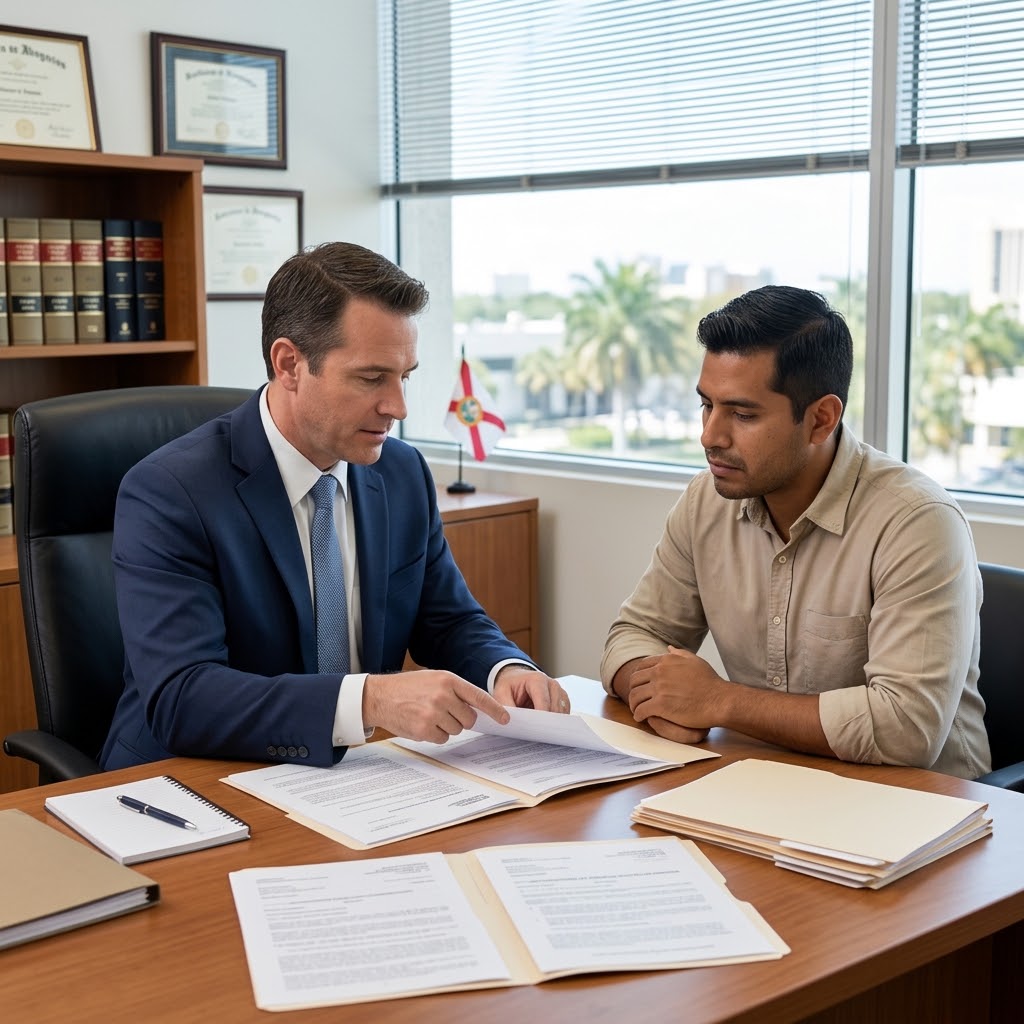
A violation of probation happens when a person under court-ordered supervision breaks a condition, such as missing a meeting with a probation officer or getting arrested again. For a noncitizen, a violation of probation Florida judges find proven can change the immigration case too.
The reason is the sentence. When a Florida court revokes probation, it can impose any sentence it could have imposed originally. A longer sentence can move a case into a different immigration category, sometimes one with far fewer options.
This guide explains what probation is and how it differs from parole, what counts as a violation, what can happen at the hearing, and where the immigration risks sit for someone who is not a U.S. citizen.
What Is Probation in Florida, and How Is It Different From Parole?
Probation is community supervision ordered by the criminal court, while criminal parole and immigration parole are separate things. Mixing them up leads to bad decisions, so it helps to separate them before looking at a violation of probation Florida case.
Probation
Fla. Stat. § 948.001(8) defines probation as community supervision that requires specified contacts with probation officers and other conditions under Fla. Stat. § 948.03. Under Fla. Stat. § 948.01, a judge can order it with an adjudication of guilt or with adjudication withheld (withhold of adjudication).
Community control
Fla. Stat. § 948.001(3) defines community control as intensive, supervised custody in the community, including surveillance on weekends and holidays. The person’s freedom is restricted to the home or another approved placement, with specific sanctions enforced.
Criminal parole
Criminal parole is the supervised release of someone who is already serving a prison sentence. In Florida, chapter 947 of the statutes governs it. It is a different tool from the probation a judge orders at sentencing.
Immigration parole
Immigration parole belongs to federal law. INA § 212(d)(5)(A), 8 U.S.C. § 1182(d)(5)(A), lets the federal government allow a person into the United States temporarily for urgent humanitarian reasons or significant public benefit, and it states that parole is not an admission.
Does Probation Count as a Conviction for Immigration?
Generally, yes, when there was a plea or finding of guilt. Immigration law defines “conviction” in INA § 101(a)(48)(A), 8 U.S.C. § 1101(a)(48)(A), and that definition does not depend on how Florida labels the outcome.
A conviction exists when a court enters a formal judgment of guilt. When adjudication is withheld, there is still a conviction if there was a guilty or nolo contendere plea, or a finding of guilt, and the judge ordered some penalty, punishment or restraint on liberty.
Probation is a restraint on liberty. So a withhold of adjudication with probation, which avoids a formal conviction under Florida law, generally counts as a conviction for immigration purposes.
INA § 101(a)(48)(B) adds a second rule: any reference to a term of imprisonment includes the period the court ordered, even if the sentence was suspended in whole or in part. A one-year sentence suspended in exchange for probation is still a one-year sentence for immigration.
What Counts as a Violation of Probation in Florida?
Florida separates technical violations from new-law violations, and the difference shapes what happens next. Fla. Stat. § 948.06(1)(c) defines a technical violation as one that is not a new felony, a misdemeanor or a criminal traffic offense.
Fla. Stat. § 948.06(9)(b) lists the “low-risk” violations when committed by a probationer:
- a positive drug or alcohol test;
- failing to report to the probation office;
- failing to report a change in address, employment or other required information;
- missing a required class, treatment or counseling session, or meeting;
- failing to submit to a drug or alcohol test;
- violating curfew;
- missing a monthly quota on restitution, court costs or community service hours;
- leaving the county without permission;
- associating with a person engaged in criminal activity.
A new arrest is a different category in any violation of probation Florida case. When there are reasonable grounds to believe a probationer violated probation “in a material respect,” Fla. Stat. § 948.06(1)(a) allows a warrantless arrest and a return to the court that ordered probation.
Once an affidavit of violation is filed and a warrant issues, or after a warrantless arrest or a notice to appear, the probation period is tolled until the court rules, under Fla. Stat. § 948.06(1)(g).
What Happens at a Violation of Probation Florida Hearing?
If the court revokes probation, it can impose any sentence it might have imposed originally. That rule comes from Fla. Stat. § 948.06(2)(b) and (e), and it is why a violation can end in a harsher sentence than the original deal.
At the first appearance, the court tells the person about the charged violation. If the person admits it, the court may revoke, modify or continue probation. If not, the court may hold the person, release them with or without bail, or dismiss the violation charge.
If the charge is neither admitted nor dismissed, Fla. Stat. § 948.06(2)(d) requires the court to give the person a chance to be fully heard, in person or through an attorney.
The law also sets limits. Under Fla. Stat. § 948.06(2)(f), for certain low-risk technical violations, when the court has not previously found a violation during the current term, the court generally must modify or continue probation, and it may add up to 90 days in county jail.
On the other side, Fla. Stat. § 948.06(8)(d) requires certain people to stay in custody until the violation is resolved, including a violent felony offender of special concern as the statute defines that term.
One more effect matters. If adjudication had been withheld, revocation requires the court to adjudge the person guilty of the original offense, under Fla. Stat. § 948.06(2)(b). The withhold is gone.
How Can a Violation of Probation Change Your Immigration Status?
Generally, the violation itself does not create a new ground of removal, but it can change the sentence, and the sentence is what triggers several categories. A revocation that raises the sentence to one year or more can turn a manageable case into an aggravated felony for immigration.
INA § 101(a)(43)(F) and (G) list as aggravated felonies a crime of violence and a theft or burglary offense when the term of imprisonment is at least one year.
A person convicted of an aggravated felony at any time after admission is deportable under INA § 237(a)(2)(A)(iii), which can lead to removal proceedings.
| Outcome of the violation hearing | What the Florida court decides | What it can mean for immigration
|
|---|---|---|
| Violation charge dismissed | Probation continues unchanged | The analysis of the original case stays the same; the violation arrest stays in the record |
| Probation modified or continued | New conditions, or up to 90 days in jail in some cases | Jail time can count toward the 180-day period that affects good moral character |
| Revocation with a sentence under one year | Adjudication of guilt and a new sentence | Generally a conviction; the effect depends on the offense category |
| Revocation with a sentence of one year or more | Adjudication and a prison sentence | Can trigger aggravated felony categories, depending on the original offense |
| New offense while on probation | A violation plus a new criminal case | A possible second conviction and a possible ICE detainer |
The table compares violation of probation Florida outcomes, not crimes. The real result depends on the statute of conviction, the actual sentence and the discretion of the prosecutor, the criminal judge, ICE and the immigration judge.
Other rules can apply. INA § 101(f)(7) bars good moral character for anyone confined for 180 days or more, as a result of a conviction, during the required period, and INA § 101(f)(8) bars it permanently after an aggravated felony conviction.
For a lawful permanent resident, cancellation of removal under INA § 240A(a) requires no aggravated felony conviction. A one-year sentence after a violation can close that path, depending on the offense.
A New Arrest on Probation and Contact With ICE in Florida
In Florida, an arrest while on probation often brings a noncitizen into contact with ICE at the county jail. State law requires that cooperation in express terms.
Fla. Stat. § 908.11 requires sheriffs and chief correctional officers who run county jails to enter written 287(g) agreements with ICE. Fla. Stat. § 908.104 requires state and local law enforcement agencies to use best efforts to support the enforcement of federal immigration law.
With an immigration detainer, ICE asks the jail to notify it before release and to hold the person up to 48 hours longer. Fla. Stat. § 908.105 requires the agency to notify the bail judge and to comply with a detainer that meets state law.
That is why posting bond in a violation of probation Florida case does not always mean going home. In some circumstances, it can speed up a transfer to immigration detention, where the process and the protections differ from the criminal system.
When that risk exists, coordinating deportation defense with the criminal defense before the violation hearing can matter.
Naturalization and Other Filings While You Are on Probation
USCIS will not approve a naturalization application while the applicant is on probation, parole or a suspended sentence. The USCIS Policy Manual says so, and the instructions for Form N-400, Application for Naturalization, repeat it.
Finishing probation does not guarantee approval. According to the Policy Manual, completing probation during the statutory period does not automatically prevent a finding of good moral character, but it can affect the overall decision.
The N-400 instructions ask for court evidence that probation ended, and the Policy Manual requires certified court dispositions in certain cases. Gather them before any filing.
If you already have a hearing date or a notice in hand, time works against you. At Angel Law Firm, you speak with an attorney about your case from the first consultation. Call (407) 329-7711 or reach our Orlando office to review your options.
Frequently Asked Questions About Violation of Probation Florida Cases
Can I be deported for violating probation?
Not necessarily, but the risk is real. A violation by itself generally is not a ground of removal; what matters is the sentence that follows and the category of the original offense.
If revocation raises the sentence to a year or more for certain offenses, or if a new arrest comes with a detainer, the picture can change quickly.
Is a withhold of adjudication with probation a conviction?
Generally, yes, for immigration. A conviction exists when there was a guilty or no contest plea and the judge imposed some restraint on liberty, and probation is one.
Florida may not treat it as a formal conviction. Federal immigration law generally does.
What if I missed a meeting with my probation officer?
It can be treated as a technical violation. Failing to report to the probation office is on the low-risk list of Fla. Stat. § 948.06(9)(b), the core violation of probation Florida statute.
For a first violation found during the term, the law generally requires the court to modify or continue probation. Even so, a warrant can lead to contact with ICE.
Can I apply for citizenship while on probation?
You can file, but USCIS will not approve the application while probation lasts. The Policy Manual and the N-400 instructions both say this.
It makes sense to time the filing once you have proof that probation ended.
Will a later sentence reduction fix the immigration problem?
It depends on the reason. The USCIS Policy Manual says later changes to a sentence matter for immigration only when they rest on a procedural or substantive defect in the original criminal case.
A reduction granted only to avoid immigration consequences generally does not change the analysis.
Violation of Probation Florida Checklist: Steps Before the Hearing or Your Next Filing
Probation ends, but a violation of probation Florida record can follow a noncitizen for years. These steps help keep the case organized:
- Read your full probation order and confirm every condition and every date.
- Keep proof of compliance: receipts, class certificates and a log of your meetings.
- Tell your criminal defense attorney you are not a citizen before admitting a violation or accepting a new sentence.
- Ask what the maximum sentence would be if probation is revoked, since the court can impose any sentence from the original case.
- Review the immigration effect of each option before the hearing, especially if the sentence could reach one year.
- Think before posting bond if ICE has lodged a detainer or could lodge one.
- Request a certified disposition when probation ends, and keep it for any immigration filing.
Florida law, immigration law and agency practice change, so confirm the current information before you decide. The violation of probation Florida rules are in Fla. Stat. § 948.06.
If you or a family member is on probation and is not a U.S. citizen, consider talking with an attorney before the next hearing.
This content is for general information only. It is not legal advice and does not create an attorney-client relationship. Every case depends on its own facts and on the law in effect when it is filed. To discuss your situation, contact Angel Law Firm at (407) 329-7711.