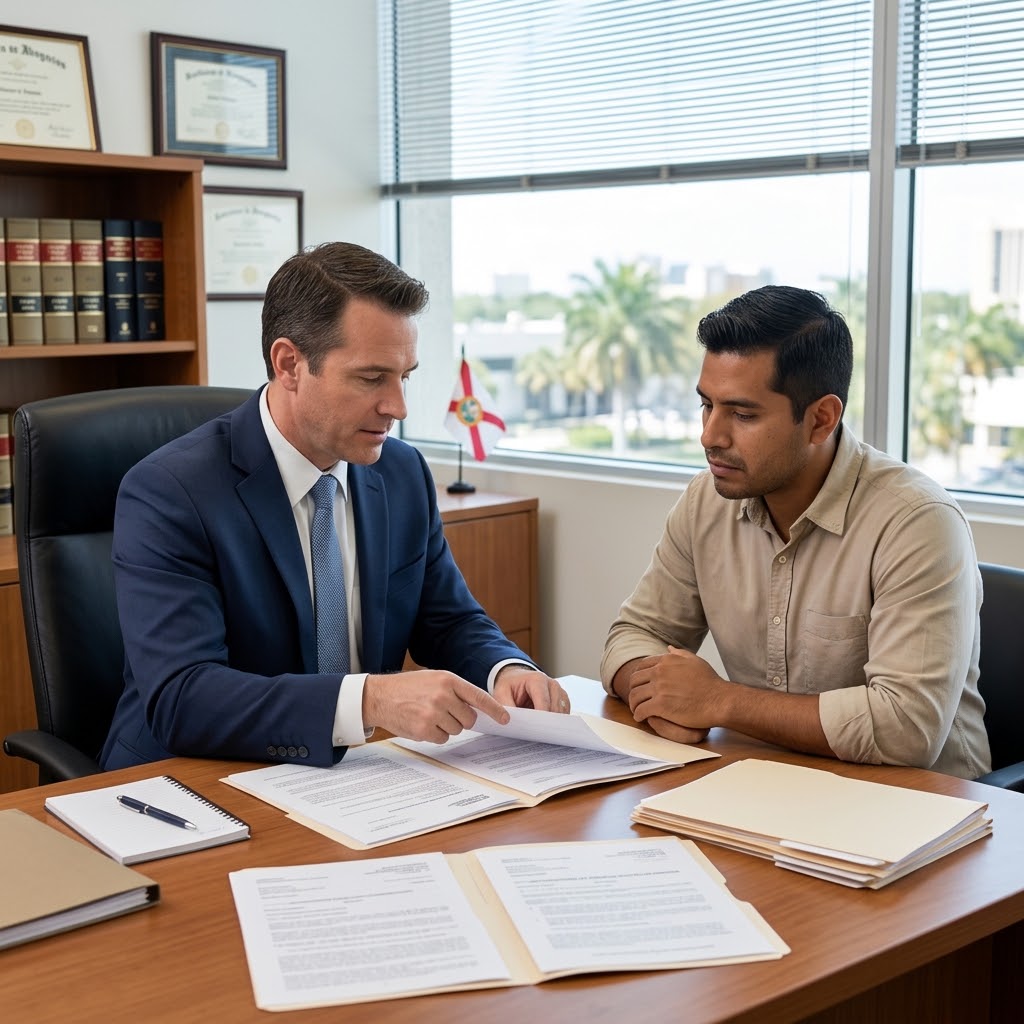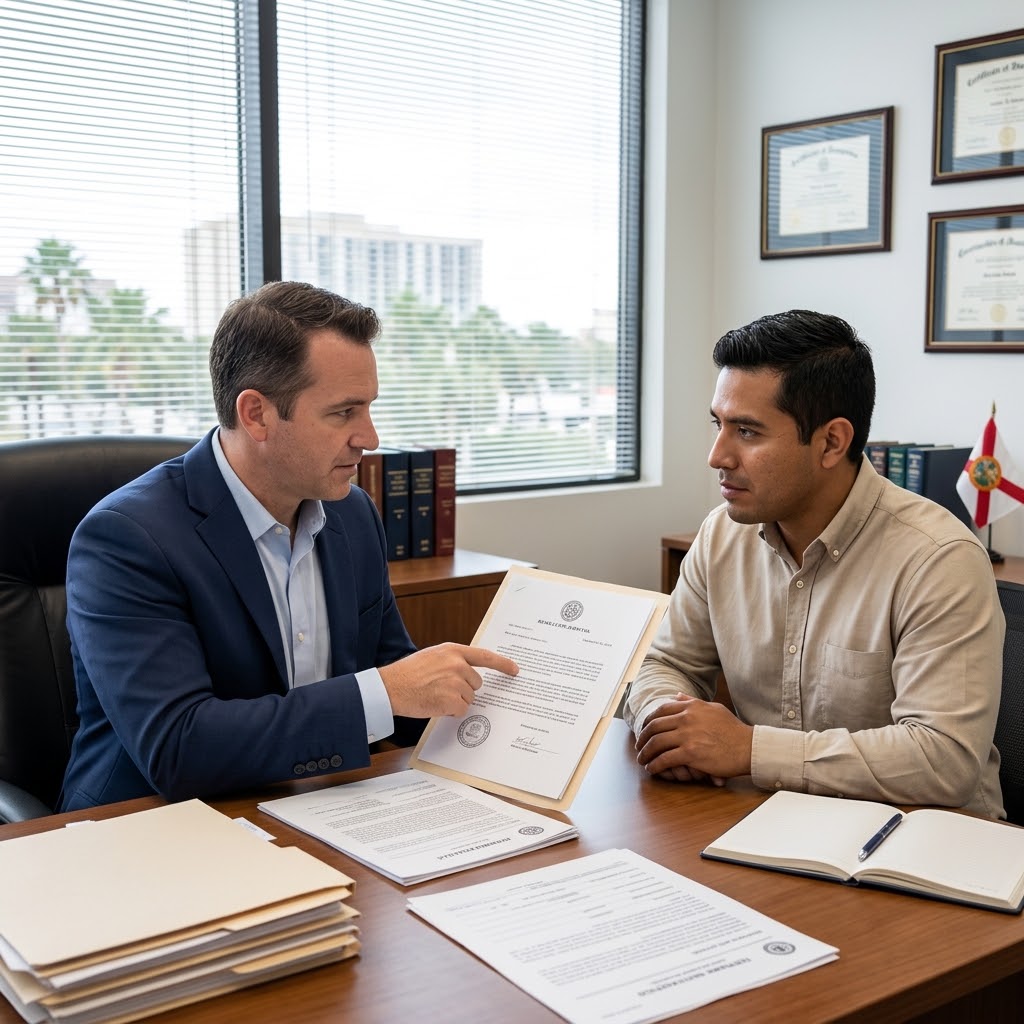
The 287(g) program is a written agreement between ICE and a state or local agency that lets ICE delegate certain immigration officer functions to local officers, under ICE’s direction and supervision. In Florida, state law requires every county jail to have one.
That means a local arrest, even for something minor, can reach ICE (Immigration and Customs Enforcement). This guide explains what 287(g) is (often searched as “287g”), how its three models work, what Florida law requires and which rights you keep if an officer with these powers stops you.
The goal is to inform, not alarm. Knowing how the system works helps you avoid the fast decisions, made in the first 24 to 48 hours, that can hurt an immigration case.
What Is 287(g) and What Does Federal Law Say?
Section 287(g) of the Immigration and Nationality Act (INA § 287(g), 8 U.S.C. § 1357(g)) was added by a 1996 law known as IIRIRA. It allows the federal government to sign written agreements with states or local governments so their officers can perform immigration officer functions.
The statute sets clear conditions:
- Written agreement: under § 1357(g)(1) and (5), the agreement spells out each officer’s powers, how long they last and who supervises them.
- Training: § 1357(g)(2) requires officers to know and follow federal law, with written certification of their training.
- Supervision: under § 1357(g)(3), officers acting under the agreement are subject to federal direction and supervision.
- No federal mandate: § 1357(g)(9) says federal law does not require any state or locality to sign.
Federal law also lets local police share a person’s immigration status with ICE without any 287(g) agreement (§ 1357(g)(10)). The agreement expands what an officer can do; basic cooperation exists either way.
The Three 287(g) Models: Jail, Street and Warrant Service
ICE runs three 287(g) models, and each one authorizes different functions. The model matters because it decides the moment when a local officer can act on someone’s immigration status.
| Model | Where the local officer acts | What it authorizes, according to ICE | What it can mean for you
|
|---|---|---|---|
| Jail Enforcement Model (JEM) | Inside the jail | Identify and process removable noncitizens with pending or active criminal charges | Immigration screening happens during jail booking |
| Task Force Model (TFM) | On the street, during routine police work or ICE-led task forces | Enforce limited immigration authority while on patrol | Immigration contact can start at a traffic stop |
| Warrant Service Officer (WSO) | Inside the jail | Serve and execute ICE administrative warrants on people in custody | A local officer can execute an ICE warrant inside the jail |
According to ICE, nominated officers are trained at ICE’s expense, and all of their immigration work happens under ICE direction and oversight. Each agency’s specific powers are set in the memorandum of agreement (MOA) it signs.
Why Is 287(g) Mandatory in Florida County Jails?
Fla. Stat. § 908.11(1) requires the sheriff or chief correctional officer who runs a county jail to sign a written agreement with ICE to take part in the 287(g) program. The law dates from 2022 (chapter 2022-193) and was amended by SB 2-C in 2025 (chapter 2025-1).
The same section adds three rules:
- Termination: the State Board of Immigration Enforcement must approve ending any of these agreements.
- Model choice: the law does not require a particular 287(g) model.
- Reporting: since April 1, 2025, jails without an agreement must report quarterly to that board on its status and any reason for noncompliance.
ICE’s participating agency list, updated September 21, 2026, shows 353 signed 287(g) agreements held by 289 Florida agencies, and 290 of those agreements were signed in 2025.
Of the 353, 279 are Task Force, 64 are Warrant Service Officer and 10 are Jail Enforcement agreements. You can read the text of Fla. Stat. 908.11.
Central Florida agencies on the list
The list includes, among others, the Orange County Sheriff’s Office (Task Force, February 26, 2025), the Orlando Police Department (Task Force, March 26, 2025) and the Florida Highway Patrol (Task Force, February 7, 2025).
It also includes the Orange County Corrections Department (WSO) and the sheriff’s offices of Osceola, Seminole and Lake counties. Nationwide, ICE reports 2,559 signed agreements in 39 states and 2 territories. The numbers change often, so check the current list.
Other Florida Laws That Expand Cooperation With ICE
287(g) is one piece of a larger chapter. Chapter 908 of the Florida Statutes sets cooperation duties that apply with or without a 287(g) agreement:
- Best efforts: § 908.104(1) requires state and local agencies to use their best efforts to support federal immigration enforcement.
- Information sharing: § 908.104(2) bars any restriction on police sending, receiving or exchanging immigration information with ICE.
- Jail rosters: under § 908.104(6), the sheriff must give ICE, on request, a list of everyone booked into the jail and their immigration status information.
- Early transfer: § 908.104(5) allows transfer to ICE of a person with a detainer up to 12 days before the release date.
- Detainer duties: § 908.105 requires notifying the bail judge, recording it in the case file, notifying the state attorney and complying with the request.
Under Florida law, a valid detainer must come with a federal warrant: Form I-200 (Warrant for Arrest of Alien) or Form I-205 (Warrant of Removal/Deportation), per § 908.102(2).
With Form I-247A, ICE asks the jail to notify it before releasing the person and to hold them up to 48 hours beyond release, excluding weekends and holidays (8 CFR § 287.7(d)).
A state law blocked by the courts
SB 4-C (chapter 2025-2) created Fla. Stat. § 811.102, which makes it a state crime for an adult who avoided immigration inspection to enter Florida. On April 29, 2025, the U.S. District Court for the Southern District of Florida issued a preliminary injunction blocking enforcement.
On July 9, 2025, the U.S. Supreme Court denied Florida’s request to stay that injunction, and the appeal was still pending before the Eleventh Circuit in the most recent records we reviewed. This is open litigation: while the injunction stands, the law cannot be enforced.
What Happens If Police Stop You in Florida?
It depends on the agency’s model and where the contact happens. At a traffic stop, a Task Force officer can use limited immigration authority. At the jail, immigration screening happens during booking.
On the street
An officer with 287(g) powers is still a local officer, acting under ICE supervision for immigration work. A stop can start with a traffic violation, such as driving without a license, and turn into questions about immigration status.
At the county jail
After an arrest, the person’s information can reach ICE. If ICE issues a detainer, the jail must comply (§ 908.105).
After a warrantless immigration arrest, 8 CFR § 287.3(d) calls for a decision within 48 hours on whether the person stays in custody or is released on bond.
Posting criminal bond while a detainer is active may not send you home; it can speed up the transfer to an ICE detention center. Rules, conditions and procedural rights there differ from the criminal system.
If the case moves forward, ICE usually issues Form I-862, the Notice to Appear (NTA), which opens removal proceedings before an immigration court run by EOIR (the Executive Office for Immigration Review).
What Rights Do You Keep When an Officer Has 287(g) Powers?
The same rights you have with any officer, plus some protections specific to immigration proceedings. The Fifth Amendment to the U.S. Constitution protects the right not to incriminate yourself, and federal immigration rules add others:
- Reasons for the arrest: under 8 CFR § 287.3(c), a person arrested without a warrant and placed in proceedings must be told the reasons for the arrest.
- A lawyer: that rule and INA § 292 recognize the right to be represented by the lawyer of your choice, though the government does not pay for one, and ICE must provide a list of pro bono legal service providers in the area.
- Your words matter: the officer must warn that any statement can be used against you later.
Do not sign papers you don’t understand: INA § 240(d) allows a stipulated removal order, and that signature is a conclusive finding that you can be removed. Ask to review any document with a lawyer first.
Do not lie or present false documents either. INA § 212(a)(6)(C) makes inadmissible anyone who uses fraud or falsely claims U.S. citizenship, and those grounds can close doors to relief that might otherwise be available.
Notarios, Rumors and “It Worked for My Cousin”
Fear spreads advice that sounds helpful and isn’t. The most important warning is about who can help: according to USCIS, a notario público or notary public is not authorized to provide immigration legal services.
Only an attorney or an accredited representative of a Department of Justice recognized organization can give immigration legal advice. USCIS explains this in its official guide to common scams.
The other mistake is comparing your case with one from years ago. Conditions have changed: 290 of the 353 Florida agreements on ICE’s list were signed in 2025, and Chapter 908 was amended the same year.
What worked for someone else may not apply to you. Once an arrest has put ICE in the picture, deportation defense starts by reviewing the criminal and immigration records together.
Understanding the process is the first step, and every case has details that change the strategy. To see how this applies to your situation, schedule a consultation with our team at Angel Law Firm in Orlando, where you speak with an attorney from the first consultation.
Frequently Asked Questions About 287(g) in Florida
Can Florida police ask about my immigration status?
In certain circumstances, yes. A Task Force officer can use limited immigration authority during routine police work, under ICE supervision. Federal law also allows any officer to share a person’s status with ICE.
Does 287(g) mean local police can deport me?
No. Local police do not order removal. Depending on the model, they can identify, arrest or hold a person, but removal is decided in proceedings before an EOIR immigration court or through the channels federal law provides.
What is a detainer, and how long can I be held on one?
It is a request from ICE to the jail. It asks the jail to give notice before release and to hold the person up to 48 hours longer, not counting Saturdays, Sundays or holidays (8 CFR § 287.7(d)). In Florida, it must come with Form I-200 or I-205.
Does every Florida county jail have a 287(g) agreement?
State law requires it. Fla. Stat. § 908.11 requires the sheriff or jail chief in each county to sign, and ICE’s list includes the sheriff’s offices of all 67 Florida counties. The model can vary by county.
Should I talk to the officer to clear things up?
Not necessarily. What you say can be used in a later proceeding, and the immigration officer must warn you of that. You can ask to speak with a lawyer before answering questions about your status or signing documents.
Living in a Florida County With 287(g): A Practical Checklist
With 287(g) in every Florida county jail, preparation matters more than luck. These steps cover the basics:
- Resolve pending tickets and citations before they turn into arrest warrants.
- Keep a lawyer’s phone number handy and share it with your family.
- Copies of your immigration papers belong in a safe place your family knows about.
- Stay calm at a stop: don’t run, don’t lie and don’t show false documents.
- Remember your right to stay silent and to ask for a lawyer.
- No signature without understanding, especially on ICE documents.
- Be wary of notarios or consultants who promise to fix your case.
Laws and immigration policy change, and several of these rules have recent amendments or active litigation, so confirm the current information. ICE posts its model descriptions and the updated agency list on its official 287(g) program page.
If you have questions about how 287(g) in Florida could affect your family, consider talking to a lawyer before an emergency happens.
This content is for general information only. It is not legal advice and does not create an attorney-client relationship. Every case depends on its own facts and on the law in effect when it is filed. To discuss your situation, contact Angel Law Firm at (407) 329-7711.